
This tutorial is an introductory overview of the diatonic chords of the major scale.
What are diatonic chords
The word diatonic means in the original Greek ‘through the tones’. This means that we construct triads on each scale degree, using only notes from within the scale without adding accidentals from outside that scale. These chords thus all “belong” naturally to the key you’re working in.
How to construct diatonic chords for the major scale
As we learnt in the tutorial on the major scale the major scale is composed of seven notes based upon a specific step pattern
W – W – H – W – W – W – H
For example, the C major scale
C – D – E – F – G – A – B – C
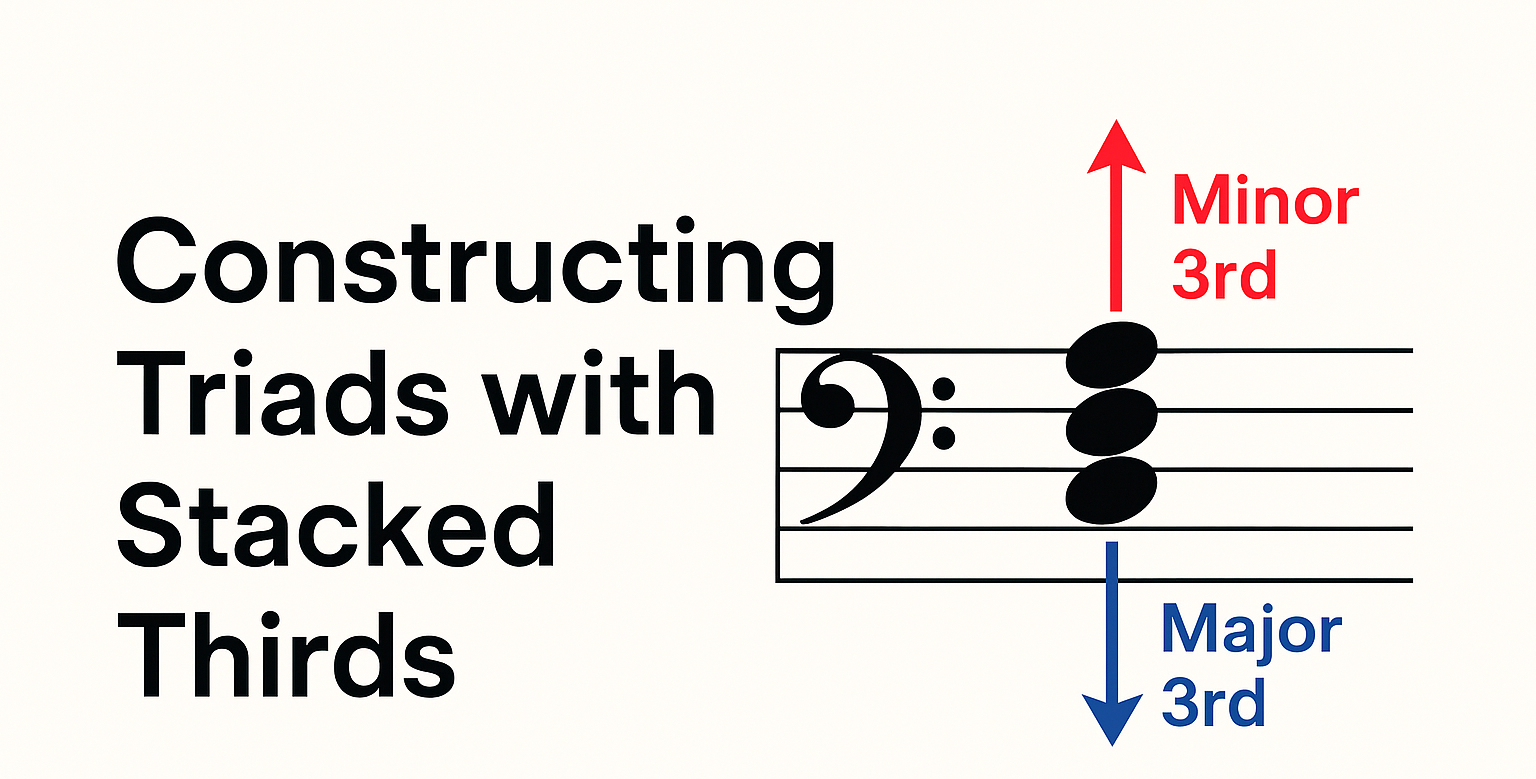
We also learnt in the tutorial on the construction of triads that we can build triads by stacking thirds.
If we start on each note of the major scale and stack thirds to create triads using only notes from the scale, we get the following combinations of notes and examining the third qualities (major or minor) we can see that the triads that are built are as follows
- C-E-G – M + m – Major Triad
- D-F-A – m + M – minor triad
- E-G-B – m + M – minor triad
- F-A-C – M + m – Major Triad
- G-B-D – M + m – Major Triad
- A-C-E – m + M – minor triad
- B-D-F – m + m – diminished triad
So, we end up with the following chords
- C Major
- D minor
- E minor
- F Major
- G Major
- A minor
- B diminished
Diatonic chords are the backbone of tonal music and are used to build harmony, create progressions, establish a key, and guide emotional movement in songs.
Some uses of diatonic chords
Here are some of the uses for diatonic chords
- Establishing Key and Tonality
- Creating Chord Progressions
- Supporting Melody
- Functional Harmony – Each diatonic chord has a role
- Improvisation & Composition
- Songwriting & Analysis
Final Thoughts
As can be seen, the process of constructing the diatonic chords for the major scale is relatively straightforward.
For a fuller treatment of the diatonic chords of the major scale the full tutorial is available in the PhysMuse Payhip store for $0.99. If you’d like to support my work, you can do so on Buy Me a Coffee — it’s always appreciated.

Leave a Reply