
Introduction
Every piece of music we love, from a simple folk tune to a full orchestral score, is built on a small set of underlying principles. They’re not rules, and they’re not formulas. They’re the structural forces that shape how music moves, breathes, and communicates.
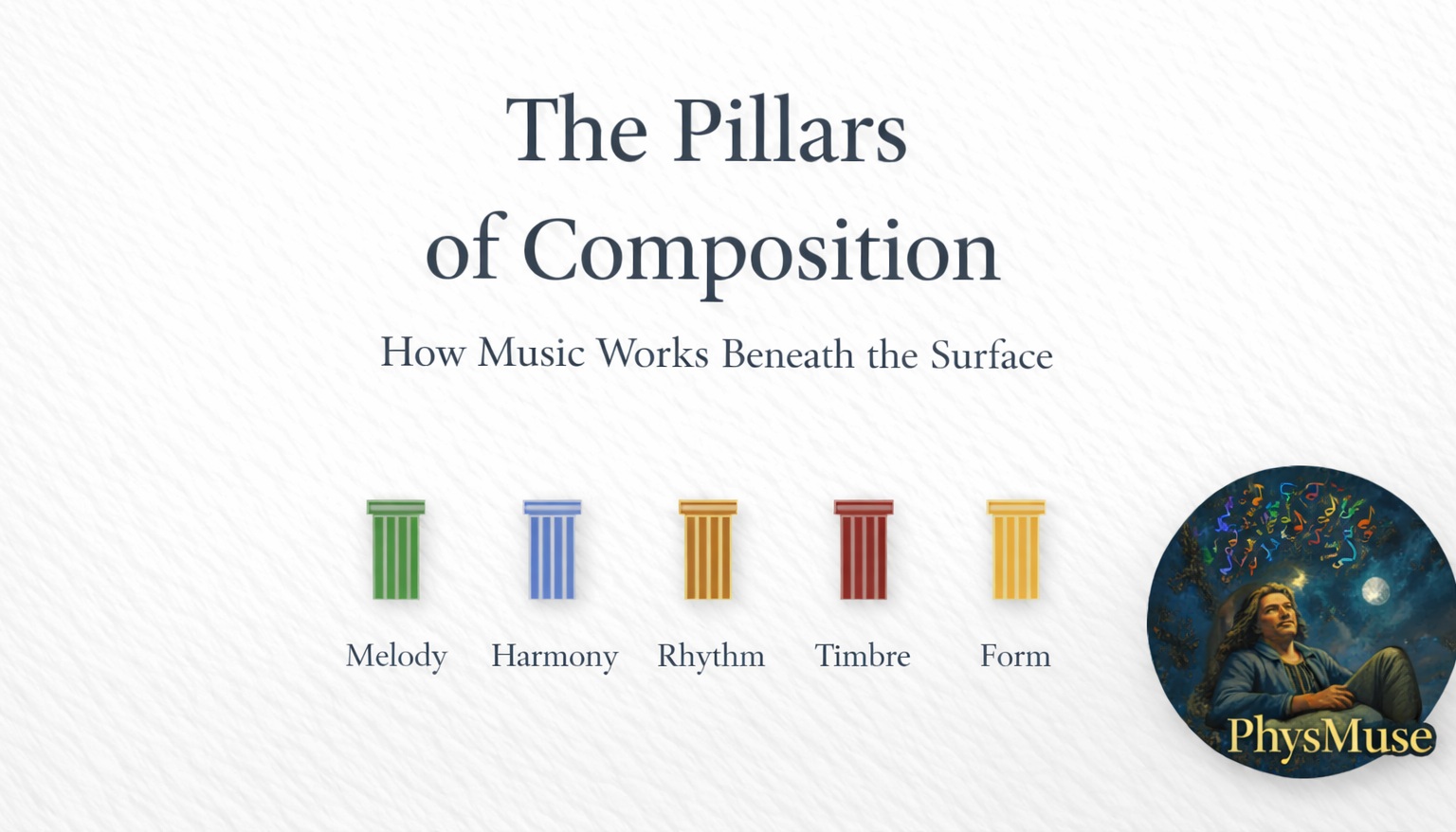
Everything in composition comes back to five core elements:
- Melody
- Harmony
- Rhythm
- Timbre
- Form
These are the pillars that support musical expression. They appear in every style, every genre, every era. Whether you’re writing a short guitar piece, a sync cue, or a larger work, these five elements are always present, interacting, balancing, and shaping the listener’s experience.
This series explores each pillar in turn as a way of understanding how music works beneath the surface. My goal is to offer a clear, approachable framework that helps you listen more deeply, write more intentionally, and recognise the patterns that make music feel coherent and alive.
Each post will focus on one pillar:
- Melody — the line of meaning
- Harmony — the gravitational field
- Rhythm — the engine of motion
- Timbre — the sound world
- Form — the architecture of ideas
Together, they create the foundation of musical thought. Separately, each one offers its own way of shaping emotion, structure, and identity.
This introduction sets the stage. In the next post, we begin with the most immediate and recognisable pillar: Melody — the element that gives music its voice.
Leave a Reply